James Hardie Garage Conversion ADU: The Los Angeles Owner’s Guide
If you’re converting a garage into an ADU in Los Angeles with James Hardie siding and trim, we stock and install the full line of James Hardie-compatible parts, including HardiePlank lap siding, HardiePanel vertical siding, HardieTrim boards, and the flashing and moisture-barrier components required for L.A. building code. Typical installed siding and trim replacement on a garage conversion ADU runs $1,800 to $5,400 depending on square footage and how much of the existing substrate needs repair. Most Los Angeles owners discover a problem the same way: a corner of HardieTrim has swollen at the bottom edge, a lap joint has cracked behind a downspout, or water staining has appeared on the interior drywall a season or two after the conversion was finished.
What matters most when a James Hardie part fails on a garage conversion is not just swapping the board. It’s finding out why it failed. In Los Angeles, that usually means a flashing detail was skipped, the clearance to grade was too tight, or the original installer used the wrong fastener. Russ Delmar has seen every one of these on garage conversions across the city, from Palms to Pacoima to Mar Vista.
Which James Hardie Models This Applies To
Garage conversion ADUs in Los Angeles typically use one of three James Hardie product lines: HardiePlank HZ5 lap siding, HardiePanel HZ5 vertical siding, or HardieTrim HZ5 boards used for corners, window surrounds, and fascia. The HZ5 designation matters. It means the product is rated for the high-moisture, high-heat conditions we get in Southern California. Older garage conversions, especially those permitted before 2015, sometimes have HardiePlank HZ10, which Hardie has since reformulated for better moisture resistance.
Here’s the compatibility gotcha most Los Angeles homeowners don’t know: you cannot mix HZ5 and HZ10 boards on the same wall and expect the lap lines to match. The board thicknesses differ by about 1/16 inch, and the shiplap profile is not identical. If your garage conversion has HZ10 and you replace a single damaged board with HZ5, the lap will sit proud and the paint line will never look right. We match the series before we order a single board.
Beyond the series, you need the correct exposure. Most Los Angeles garage conversions use a 5-inch or 7-inch exposure on HardiePlank. Measure from the bottom of one course to the bottom of the next. That tells us whether we’re matching HardiePlank 5.25-inch or 8.25-inch lap siding. For HardiePanel, garage conversions typically use 4×8 or 4×10 sheets in a Sierra 8 or Stucco texture. And HardieTrim comes in 1×4, 1×6, and 5/4 widths, with the most common garage conversion failure being the 1×6 used as a water table at the garage slab transition.
As for OEM versus aftermarket: we install James Hardie products for the siding and trim itself. For flashing, moisture barrier, and fasteners, we use brands chosen for compatibility with Hardie’s installation spec, including stainless steel nails and either Tyvek or HardieWrap depending on the wall assembly. Lodgewick ADU Los Angeles is an independent service provider, not affiliated with James Hardie, but we follow the Hardie installation manual to the letter because warranty replacement on a failed board is only honored when the install was done to spec.
Signs Your James Hardie Garage Conversion ADU Is Failing
- Swollen or delaminating HardieTrim at the bottom edge. This is the number-one failure on Los Angeles garage conversions, especially where a driveway was converted to a pathway and the trim now sits closer to grade than the 2-inch clearance Hardie requires. Water wicks up, the fibers swell, and the board starts to split. The board needs replacement, and the grade or drainage usually needs adjustment too.
- Cracked lap boards behind a downspout or at the inside corner of a garage door infill wall. When a garage door opening is framed in and sided over, the seam between the new infill wall and the original garage frame is a stress point. Slight settle or thermal movement cracks the siding. We see this a lot in the hillside neighborhoods of Los Angeles where garages were built into slopes.
- Water staining on interior drywall, especially at the bottom plate line. By the time this shows up, the exterior failure has been underway for months. The moisture got past the siding and the barrier. On garage conversions, the usual culprit is a missing or improperly lapped piece of flashing at the transition from the slab to the wall.
- Visible nail heads or “nail pops” along lap courses. Hardie siding should be face-nailed with the fastener flush and painted. If you can see nail heads from ten feet away, someone over-drove them. Water channels down the nail and into the wall. Each nail is a small leak, and in a Los Angeles rain year, small leaks add up.
- Paint peeling in vertical streaks from the lap joint. This is the telltale sign that water is sitting in the shiplap joint instead of draining away. The lap was either installed too tight at the edge or the flashing at the garage door header is dripping water down the wall face. We fix the drainage, replace the damaged board, and repaint the wall so the finish matches.
Replacement Cost & What’s Included
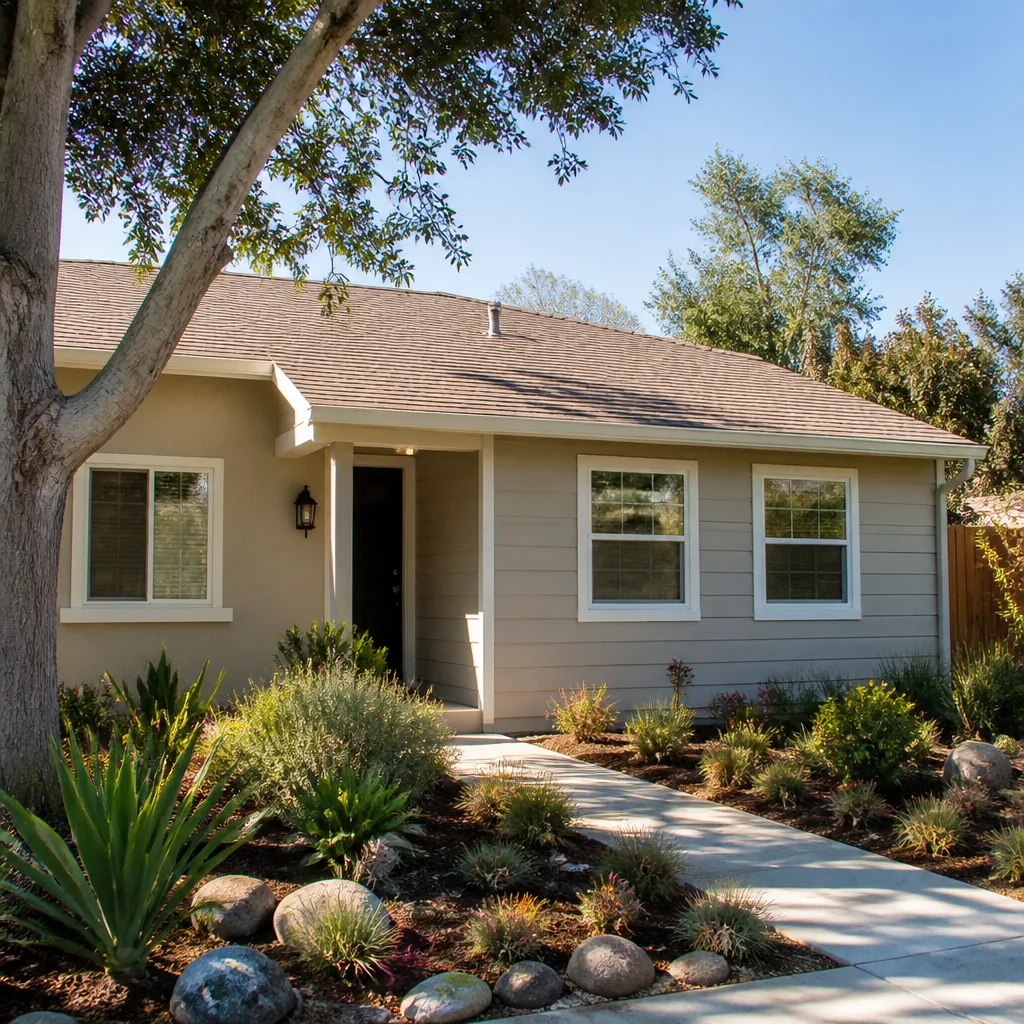
For a Los Angeles garage conversion ADU, here’s what you’re looking at, installed:
- Single HardieTrim board replacement (1×6, painted to match): $180 to $320
- Single HardiePlank lap board replacement, including flashing correction: $220 to $410
- Partial wall re-side on a standard one-car garage conversion: $1,800 to $3,200
- Full garage conversion ADU re-side, including trim, flashing, and paint: $3,800 to $5,400
The range depends on what we find behind the siding. If the original garage wall was stucco and the conversion crew furred out for Hardie, we may have to adjust the furring strips to fix a drainage plane. If the bottom plate has rot, that’s framing repair, not just siding. We’ll tell you the written price before any work starts. No price changes at the door. And every replacement carries the 365-Day Done Right Promise: if the work isn’t right, we come back and make it right, in writing.
DIY or Call Us?
Here’s the honest split. You can safely check a few things yourself: measure the exposure, note the color code if it’s written on the back of a spare board, and confirm whether the house paperwork lists HZ5 or HZ10. You cannot safely remove a damaged HardieTrim or HardiePlank board on a garage conversion without risking the moisture barrier and the flashing behind it. Fiber cement is heavy, brittle at the edges, and when you pry a board off, you often take the barrier with it. If the barrier tears and you side back over it, you’ve created a hidden leak that will go unnoticed until the drywall swells.
The other thing we’d caution: matching paint on James Hardie in Los Angeles sun is not simple. Factory finish colors fade, and a board that matches today won’t match in six months unless you repaint the whole elevation. We handle that as part of the job. If you want the board replaced right and matched, call (213) 698-7116 and we’ll give you a written quote, a real arrival window, and a guarantee in writing before we start.
FAQs
James Hardie warrants HZ5 siding for 30 years on the non-prorated portion when installed to their spec, and in Los Angeles we routinely see it perform for 25 to 35 years when the flashing and clearances are right. Most failures we see on garage conversions are not product failures. They’re installation failures at flashings, grade clearances, or fasteners. Call (213) 698-7116 if you want us to inspect a failing area and tell you what’s actually going on.
Small chips and hairline cracks can sometimes be repaired with approved patching compound and paint, but if the board has delaminated, swollen at the edge, or cracked through its full thickness, it needs replacement. Patching a delaminated board is a temporary fix at best, and on a Los Angeles garage conversion it almost always fails within a season or two. We’ll tell you straight which situation you have, and we’ll put the recommendation in writing.
One or two boards typically take half a day, including paint matching and caulk cure time. A partial wall re-side runs one to two days. A full garage conversion ADU re-side runs three to five working days, depending on what’s behind the siding. You’ll get an arrival window in writing before we start, and our crew leaves the job site cleaner than they found it.
We stock the most common Los Angeles garage conversion profiles on our trucks: HardiePlank HZ5 in 5.25-inch and 8.25-inch exposures, HardieTrim 1×4 and 1×6, and HardiePanel in the two most requested textures. Uncommon textures or older HZ10 series boards we order from our local Los Angeles supplier, which usually takes two to three business days. Either way, you get a firm written price before we order anything.
If your James Hardie garage conversion ADU has a failing board, a swelling trim piece, or a leak you can’t source, call (213) 698-7116. Russ Delmar and the Lodgewick ADU Los Angeles team will give you a straight answer and a written price. Tell us what you need the space to do, and we’ll tell you exactly what it’s going to take. No guessing, no runaround.
Written by Russ Delmar, Owner, Lodgewick ADU Los Angeles at Lodgewick ADU Los Angeles, serving Los Angeles and nearby areas.