Last updated October 15, 2026
How to Hire a ADU Contractor in Los Angeles: A Step-by-Step Guide
Of the roughly 3,500 licensed contractors in Los Angeles County, fewer than 400 have pulled more than five ADU permits. That means if you grab a random referral from a neighbor or an online directory, the odds that person has real accessory dwelling unit experience are worse than one in eight. You are not hiring a builder. You are hiring someone who has navigated the Los Angeles Department of Building and Safety, stood through plan checks, and absorbed the cost of their own permit mistakes before you ever met them. This guide gives you a concrete vetting protocol, from reading a contractor’s actual permit history on the public LADBS portal to structuring a payment schedule that protects you from paying for work that does not exist yet.
Quick Answer
To hire an ADU contractor in Los Angeles, verify their permit history on the LADBS public portal, insist on a written price lock before work starts, confirm they pull permits in their own name (not yours), and structure payments so you never pay ahead of completed work. The contractor you choose should be able to name the specific LADBS plan check issues they have resolved, not just tell you they have built ADUs before. A legitimate ADU builder in Los Angeles will put the price, the permit responsibility, and the completion guarantee in writing without being asked twice.
Table of Contents
- Step 1: Check Their Real ADU Permit History on LADBS
- Step 2: The Five Contract Clauses That Separate ADU Builders From General Contractors
- Step 3: Why the Lowest Bid Is Almost Always the Most Expensive
- Step 4: Interview Questions That Reveal Whether They Know Current California ADU Law
- Step 5: Structuring a Payment Schedule That Protects You
- Red Flags You Should Never Ignore
- Common Mistakes to Avoid
- When to Call a Professional
- Frequently Asked Questions
Step 1: Check Their Real ADU Permit History on LADBS
Do not ask a contractor for references. References are curated. Ask the public record instead.
The Los Angeles Department of Building and Safety keeps a searchable permit database at ladbs.org. You can look up any contractor by their license number or business name and see every permit they have pulled in the city. Here is what you are looking for:
- Permit type: You want to see permits specifically listed as accessory dwelling unit, not just room additions or remodels. An ADU permit in Los Angeles triggers a different review path, including separate inspections for foundation, framing, electrical, plumbing, and final occupancy.
- Volume: A healthy ADU track record in Los Angeles means at least five completed ADU permits in the last five years. More is better. A contractor who has pulled two ADU permits since 2019 is still learning on someone’s property, and that someone should not be you.
- Status history: Look at whether their permits show repeated correction notices or failed inspections. Every builder gets an occasional correction. A pattern of failures on the same permit suggests they do not understand what LADBS inspectors flag.
- Plan check history: The LADBS portal shows when a plan was submitted and when it was approved. A long gap between those dates can mean the contractor submitted incomplete drawings and spent weeks resolving corrections.
We have seen homeowners in Los Angeles neighborhoods like Tarzana, Eagle Rock, and West Adams hire contractors who claimed ADU experience but had only ever pulled permits for kitchen remodels. The tell is always in the permit history. If a contractor hesitates to give you their license number so you can look this up yourself, that is your answer.
The state of California also requires contractors to list their license number on all contracts, bids, and even work vehicles. If that number is missing, walk away. You can cross-check the license on the Contractors State License Board website to confirm it is active and see any disciplinary actions.
Step 2: The Five Contract Clauses That Separate ADU Builders From General Contractors
Most contractor disputes in Los Angeles come down to five things: the price changed, the permits were not pulled, the site was left a mess, the inspection failed and nobody fixed it, or the work was never finished and nobody came back. A serious ADU contractor addresses all five in the contract before you sign. A general contractor who occasionally takes ADU jobs leaves all five vague and hopes you do not notice.
Here are the five clauses to demand:
- Written price lock. The contract must state a fixed price for the agreed scope, with change orders only for work you request in writing. If a contractor says the price will “depend on what we find,” they are telling you they have not done the homework. At Lodgewick ADU Los Angeles home, a written price is provided before any work starts, every time, no exceptions.
- Permit-pull responsibility. The contract should state that the contractor, not the homeowner, pulls all required permits in the contractor’s name and is responsible for scheduling and passing all inspections. In Los Angeles, a homeowner who pulls their own permit for a contractor becomes the general contractor in the eyes of the law, which means liability for job site injuries falls on the homeowner. That is a five-figure risk you do not want.
- Site-clean standard. The contract should specify that the job site is cleaned daily, debris is removed on a defined schedule, and the property is restored to a clean condition at project end. A vague “we’ll clean up” is not enough. You want it written, with a defined frequency.
- Inspection-fail protocol. The contract should state what happens if an LADBS inspection fails. Who schedules the reinspection? Who pays for the correction? Who covers the delay costs? A serious ADU builder in Los Angeles has failed an inspection before and knows the correction process. Putting the protocol in writing protects you from paying for someone else’s learning curve.
- Written completion guarantee. The contract should include a written guarantee on the completed work, with a defined duration and a defined remedy. Lodgewick operates under the 365-Day Done Right Promise: if the work is not right, we come back and make it right. That commitment is in writing on every project before work begins.
These five clauses are not negotiable niceties. They are the difference between a contractor who manages risk and a contractor who transfers risk to you.
Step 3: Why the Lowest Bid Is Almost Always the Most Expensive
In Los Angeles, ADU construction costs typically run between $250 and $450 per square foot, depending on whether you are doing a garage conversion, a stick-built unit, or a prefab install. A detached 800-square-foot ADU usually lands between $200,000 and $360,000 all-in. If one bid comes in at $120,000 for the same scope, that is not a bargain. That is a contractor who has not priced the permit fees, the utility connection costs, or the soils report.
Here is what gets left out of a low ADU bid in Los Angeles:
- LADBS permit fees. ADU permit fees in Los Angeles vary by project but routinely run $3,000 to $8,000 depending on size, scope, and whether utility connections require separate reviews. A contractor who forgets to include these fees is not doing you a favor; they are billing you for it later.
- Utility connection costs. Connecting a new ADU to sewer, water, and power can cost $10,000 to $30,000 depending on how far your ADU sits from existing lines. On a hillside lot in Los Angeles, those costs can double. A low bid rarely includes real utility connection numbers.
- Soils report. Los Angeles has some of the most geologically varied building conditions in the country. Parts of the San Fernando Valley sit on sandy soil; parts of the hillsides sit on bedrock. A soils report, required for many ADU projects, costs $2,000 to $5,000 and can change your foundation requirements entirely. A low bid ignores this until the report comes back and the foundation price jumps.
- Plan check corrections. The LADBS plan check process almost always generates correction requests. A contractor who has been through it knows this and prices for it. A contractor who has not been through it does not price for it and sends you a change order when the corrections arrive.
The math is simple. A contractor who has pulled ADU permits in Los Angeles before has already absorbed the cost of learning what LADBS requires. That knowledge is baked into their bid. The contractor who has not pulled those permits will learn on your project, and you will pay for that education in change orders.
Step 4: Interview Questions That Reveal Whether They Know Current California ADU Law
California ADU law has changed significantly in the last three years. A contractor whose knowledge stopped updating in 2021 will give you wrong answers about what you can build on your lot. Here are the interview questions that separate current knowledge from outdated assumptions:
- “What is the current maximum size for a detached ADU in Los Angeles?” Under current California law, a detached ADU can be up to 1,200 square feet, though Los Angeles-specific zoning overlays can reduce that. A contractor who says 800 square feet is working from old law.
- “How does Senate Bill 9 affect my lot?” SB 9 allows lot splits and additional units in some single-family zones. A contractor who cannot explain what SB 9 does and does not allow on your specific lot is not the one you want.
- “Do I need a soils report for a garage conversion?” In Los Angeles, a garage conversion where the existing slab is being reused may not require a full soils report, but a new detached ADU usually does. A contractor who does not know the difference may be planning to skip a required step, which will surface later as a stop-work order.
- “What is the current impact fee situation for ADUs under 750 square feet?” California law exempts ADUs under 750 square feet from impact fees. A contractor who has never heard of this exemption has not been paying attention to the law that governs their work.
- “Who schedules the LADBS inspections, you or me?” The right answer is the contractor. If they say the homeowner handles inspections, you are being asked to act as your own general contractor, which reclassifies the legal relationship and shifts liability to you.
You do not need to know the answers to these questions yourself. You need to hear confidence and specificity from the contractor. Listen for the person who can explain the nuance, not the person who deflects with “we’ll figure that out later.” We have worked with prefab builders like Abodu and materials suppliers like James Hardie on enough Los Angeles ADUs to know that the contractors who succeed here are the ones who treat LADBS as a known quantity, not a mystery.
Step 5: Structuring a Payment Schedule That Protects You
The single most effective protection a homeowner has in an ADU project is the payment schedule. A contractor who demands 50% upfront is asking you to finance their cash flow with your risk. A reasonable payment schedule for an ADU in Los Angeles looks like this:
- Deposit: 10 – 15% at contract signing. This covers mobilization, initial materials ordering, and plan preparation. It should never exceed 15%.
- After foundation and framing pass inspection: 25%. You are paying for tangible, inspected progress, not promises.
- After rough electrical, plumbing, and mechanical pass inspection: 25%. Again, inspected work only.
- After drywall, finishes, and final LADBS inspection pass: 25%. The structure is complete and approved.
- Retainage: 10% held until punch list completion and final walkthrough. This is your leverage. Never release the retainage until every item on the punch list is done in writing.
- No LADBS permit history despite claiming ADU experience. If they cannot point to a single ADU permit in the public portal, they have not built an ADU in this city.
- “We’ll pull the permit under your name to save time.” That is not time savings. That is liability transfer. In Los Angeles, the permit holder is the responsible party for the job site. Never agree to this.
- A price that changes based on “what we find.” A contractor who has done their homework knows what they will find. A contractor who has not done their homework bills you for the discovery.
- Pressure to sign before you can check references or permit history. There is no legitimate ADU project that requires a signature this week. Los Angeles has thousands of contractors. The good ones do not need artificial deadlines.
- No written guarantee on completed work. An ADU is a six-figure investment. A contractor who will not guarantee it in writing is telling you they do not stand behind their own work.
- A bid that is 30% lower than the next closest. See Step 3 above. That money is coming out of your pocket one way or another.
- Hiring the first contractor recommended by a neighbor without checking LADBS permit history. A good neighbor can still have hired a bad contractor and not know it. Check the public record before you write a check.
- Signing a contract without a written price lock. In Los Angeles, verbal price agreements are worth nothing when the change order arrives. Get it in writing or get a different contractor.
- Paying too much upfront. A contractor who takes 50% of a $300,000 ADU before breaking ground has no financial incentive to finish. Keep the deposit at 15% or less.
- Skipping the soils report to save money. On Los Angeles hillside lots, skipping a soils report can mean foundation problems that cost ten times what the report would have. Do not cut this corner.
- Assuming a general contractor is an ADU contractor. They are different skill sets. A great kitchen remodeler may have never dealt with LADBS ADU plan check. Ask for ADU permit history specifically.
- Paying the final 10% before the punch list is done. That retainage is your only leverage once the crew leaves. Hold it until every item is resolved in writing.
- Ignoring the permit history gap. If a contractor has been licensed for a decade but has no ADU permits in the last five years, that experience is not current. California ADU law changed too much too fast for old knowledge to stay relevant.
Never pay cash. Always pay by check or credit card, and always get a receipt that ties the payment to a specific milestone in the contract. In Los Angeles, where ADU projects routinely run six to nine months, a payment schedule is the difference between a contractor who is motivated to finish and a contractor who is motivated to start another job with your money.
Red Flags You Should Never Ignore
Some warning signs are obvious, like a contractor who will not put anything in writing. Others are more subtle and specific to Los Angeles. Here is what to watch for:
Common Mistakes to Avoid
When to Call a Professional
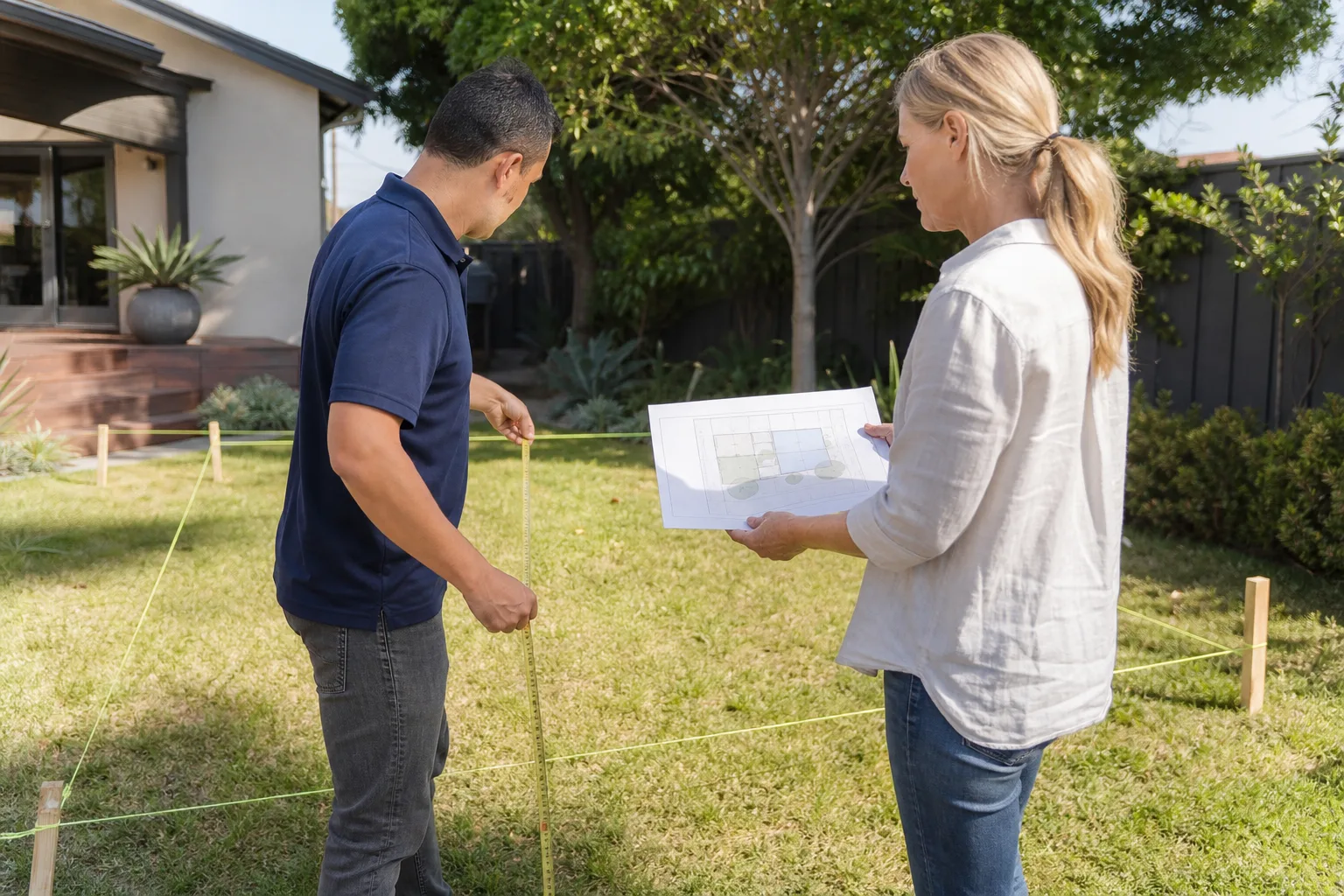
You are ready to call an ADU contractor when you have a real lot, a real budget, and a clear idea of what you want to build. You do not need final drawings or an architect before the first call. A serious ADU builder in Los Angeles can walk your site, talk through what your lot will support, and give you a written price range before any design work happens. If you are unsure whether your garage is structurally sound enough to convert, or whether your lot in a hillside neighborhood like Mount Washington or Baldwin Hills can support a detached unit, call a specialist. The guidance should be free, the price should be written, and the person on the phone should be a person. ADU Builders in Los Angeles offers free estimates with the 365-Day Done Right Promise behind every project. Call (213) 698-7116 to schedule a written estimate.
Frequently Asked Questions
ADU construction in Los Angeles typically runs $250 to $450 per square foot, which puts a standard 800-square-foot detached unit between $200,000 and $360,000 all-in, including permits, utility connections, and site work. Garage conversions are usually on the lower end of that range while stick-built detached units trend higher. Call (213) 698-7116 for an exact written quote on your specific lot and scope. Estimates are free.
Search the contractor’s name or license number on the LADBS public portal at ladbs.org, which shows every permit they have pulled in the city along with inspection status and any corrections. Look specifically for permits listed as accessory dwelling unit or ADU and check whether those permits passed final inspection. A healthy track record means multiple completed ADU permits in the last five years.
A reasonable deposit for an ADU project is 10 – 15% of the total contract price, never more. The remaining payments should be tied to specific milestones that pass LADBS inspection, with 10% held as retainage until the punch list is complete and you have done a final walkthrough. If a contractor asks for 50% upfront, that is a red flag. Call (213) 698-7116 to see how a written price and a milestone-based payment schedule work in practice.
Most new detached ADUs in Los Angeles require a soils report, which costs $2,000 to $5,000 and informs the foundation design. Garage conversions where the existing slab is being reused may not require a full report, but a contractor should be able to tell you which applies to your specific project. A soils report is not a corner to cut, especially on hillside lots where soil conditions vary dramatically by neighborhood.
A typical ADU in Los Angeles takes six to nine months from the first planning call to final LADBS inspection, assuming no major plan check delays. Garage conversions can be faster, detached new builds slower, and prefab systems like those from Plant Prefab or Tuff Shed can shorten framing time meaningfully. The LADBS plan check process alone often takes four to eight weeks, so a contractor who promises a three-month ADU is not being realistic.
It should not, if you have a written price lock in your contract. Change orders should only occur when you request a change to the scope, not when the contractor “discovers” something they should have anticipated. A contractor who has pulled ADU permits in Los Angeles before knows what LADBS will require and prices for it. Call (213) 698-7116 for a written price before any work starts, with no price changes at the door.
The Bottom Line
Hiring an ADU contractor in Los Angeles is a vetting exercise, not a bidding exercise. The contractor you trust with your property should be able to show you a public record of completed ADU permits on the LADBS portal, put a written price lock in your contract, take responsibility for permits and inspections in their own name, and structure payments so you never owe more than the work that has passed inspection. The 365-Day Done Right Promise means every Lodgewick project comes with a written guarantee and a free return visit if the work fails within the guarantee period. The Garage Conversion Contractor in Los Angeles team and our Home Addition Contractor in Los Angeles team follow The Kingswell Way: written price first, arrival window, clean job site, and a written guarantee on every project. If you want to know what your ADU will cost before you commit to anything, call (213) 698-7116 for a free written estimate.
Written by Russ Delmar, Owner at Lodgewick ADU Los Angeles, serving Los Angeles since 2010. For more guides & resources, visit our blog.